Why Crypto Investors Still Face Questions After Selling Through Regulated Platforms

Thursday, 26/11/2026 | 06:04 GMT by Yaroslav Meretskyi
  • MiCA authorisation does not guarantee smooth crypto withdrawals, as banks still need evidence of fund origins, ownership and tax residence.
  • Jurisprudential Consulting’s Yaroslav Meretskyi highlights why crypto firms must bridge the gap between trade records and cross-border compliance.
crypto

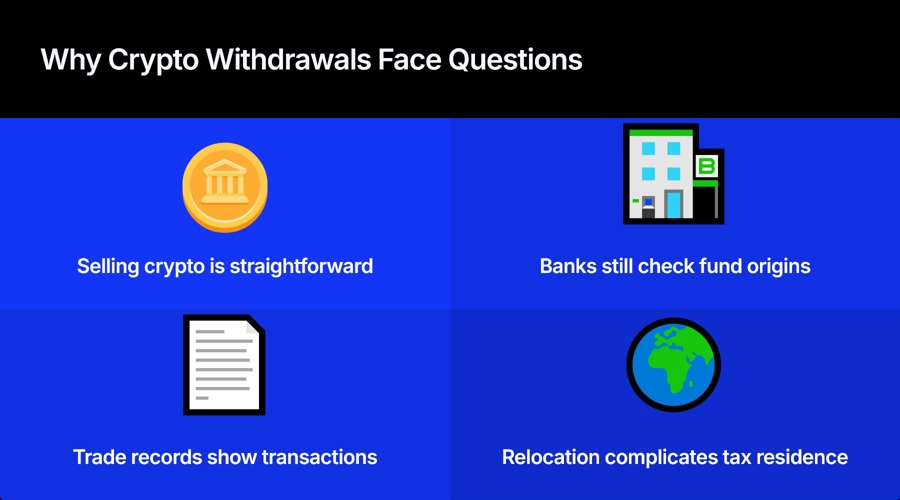
A crypto investor can sell through an authorised European platform and still struggle to explain the resulting bank payment. The platform can identify its customer and document the sale. That does not establish how the investor originally acquired the assets, whether the money belongs to the investor or a company, or which country should tax the result.

For brokers and crypto-asset service providers, this is a product design challenge. Customers who have moved to another country want their proceeds credited to the right account, a clear record and a tax position they can defend. Each part needs evidence, which may come from different institutions. Completing a trade is just one step in the process.

What Authorisation Establishes

Yaroslav Meretskyi, Co-founder and CEO Jurisprudential Consulting Group

MiCA establishes conditions for providing crypto-asset services in the EU, including authorisation and, for certain existing financial institutions, the route under Article 60. It also regulates how providers conduct their business. Legal permission to operate is a statement about the provider and its services. It is not a certificate approving every client's financial history.

The receiving bank has its own assessment to make. Under the EU anti-money laundering framework, ongoing customer due diligence includes checking that transactions are consistent with the institution's knowledge of the customer and, where necessary, the source of funds. A transfer from an authorised exchange is relevant evidence, but it need not answer the bank's underlying questions.

Transfer information addresses another part of the problem. EU rules require information about originators and beneficiaries and impose additional assessment requirements for certain transfers involving self-hosted addresses. They help connect a movement to identified parties. They do not establish the original purchase price or settle the customer's tax liability.

A Relocation Exposes the Gaps

Imagine a founder who bought crypto-assets a few years before moving to another country. After relocating, she sells part of her holdings for EUR 240,000 through an authorised platform and asks for payment to her new personal bank account. Her identity is up to date, the trade is recorded and the payment beneficiary matches the account holder.
crypto

The bank still asks where the capital came from. The founder supplies a trade confirmation showing EUR 240,000. This proves something useful about the sale but leaves the earlier acquisition unexplained. Was it funded from salary, a company distribution, a business sale or borrowing? Did she own the assets personally throughout? Which documents connect the original money to the assets now being sold?

These are different questions from whether the exchange passed its regulatory assessment. They also require different documents. A dividend resolution may explain a payment's legal basis; a bank statement may show its execution ; an exchange record may show the crypto purchase. No single document should be expected to prove the entire history.

The move raises a separate question about tax residence. DAC8 requires reporting providers to obtain and assess tax-residence self-certifications and to respond when changed circumstances make an existing certification unreliable. A current postal address should therefore not be treated as a complete tax-residence determination.

In the hypothetical case, the founder should establish the relevant residence position and dates before relying on a tax treatment. The applicable domestic rules and any relevant treaty must be examined. The platform should preserve what the customer declared, when it changed and what evidence was considered, without presenting its reporting classification as a personal tax ruling.

Design the Handover Before the Sale

I would start the customer journey with the intended use of the proceeds. Buying a home, making a shareholder investment and moving personal savings into a new banking relationship involve different recipients and documentary needs. Asking about the destination early helps identify the evidence required before a payment is initiated.

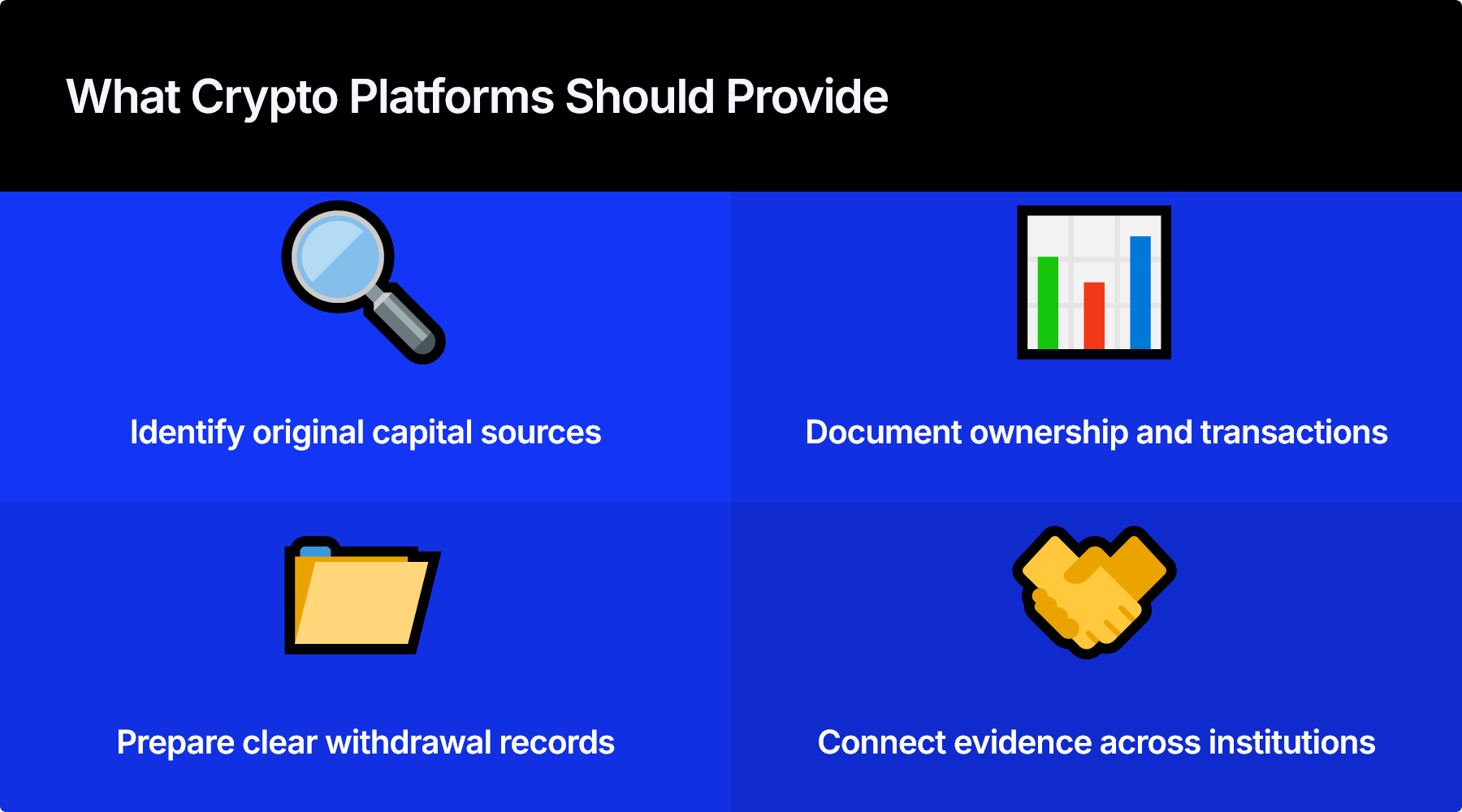
Next, organise the evidence around questions the customer can answer. What generated the original capital? Who owned it? How did it become the current holding? What transaction is proposed now? The request should clearly explain what gap needs to be filled. A generic instruction to upload proof of wealth can produce a large file without resolving the actual issue.

The provider's contribution should be specific. An export can identify the account holder, relevant deposits, executed trades, quantities, currencies, charges and withdrawal references. Where historical acquisition data is unavailable, that limitation should remain visible. Importing a customer's estimate into a report should not turn it into a verified fact.

A tax expert can then evaluate the chronology against the applicable law. A bank can assess the proposed receipt under its own controls. Neither should need to reconstruct the provider's data from screenshots if a usable record already exists. The institutions retain their separate responsibilities; the practical improvement is a clearer transfer of evidence between them.

There are limits. A complete file cannot compel a bank to accept a payment, make an unlawful source of funds lawful or change the fact that a declaration was not filed. Historical tax problems may require a lawful correction or disclosure process in the relevant jurisdiction. Better presentation is useful only when it accurately represents the underlying facts.

Make the Promise Match the Service

MiCA requires client information, including marketing communications, to be fair, clear and not misleading. Providers should apply that discipline when describing what their regulated status means for a customer. A statement about authorised services should not imply that moving assets onto the platform resolves every legal or tax issue attached to them.

There is a stronger proposition available: help clients leave with records that another professional can understand and verify. Product teams can measure whether exports answer predictable bank questions, whether changes in residence are reported and whether unresolved ownership issues are escalated before withdrawal. Those are concrete service improvements, even when the final outcome remains outside the provider's control.

Cross-border clients carry a financial history with them. A platform that recognises that history can make a regulated service more useful. The next step is to connect the trade to the evidence needed for the capital's intended use.

A crypto investor can sell through an authorised European platform and still struggle to explain the resulting bank payment. The platform can identify its customer and document the sale. That does not establish how the investor originally acquired the assets, whether the money belongs to the investor or a company, or which country should tax the result.

For brokers and crypto-asset service providers, this is a product design challenge. Customers who have moved to another country want their proceeds credited to the right account, a clear record and a tax position they can defend. Each part needs evidence, which may come from different institutions. Completing a trade is just one step in the process.

What Authorisation Establishes

Yaroslav Meretskyi, Co-founder and CEO Jurisprudential Consulting Group

MiCA establishes conditions for providing crypto-asset services in the EU, including authorisation and, for certain existing financial institutions, the route under Article 60. It also regulates how providers conduct their business. Legal permission to operate is a statement about the provider and its services. It is not a certificate approving every client's financial history.

The receiving bank has its own assessment to make. Under the EU anti-money laundering framework, ongoing customer due diligence includes checking that transactions are consistent with the institution's knowledge of the customer and, where necessary, the source of funds. A transfer from an authorised exchange is relevant evidence, but it need not answer the bank's underlying questions.

Transfer information addresses another part of the problem. EU rules require information about originators and beneficiaries and impose additional assessment requirements for certain transfers involving self-hosted addresses. They help connect a movement to identified parties. They do not establish the original purchase price or settle the customer's tax liability.

A Relocation Exposes the Gaps

Imagine a founder who bought crypto-assets a few years before moving to another country. After relocating, she sells part of her holdings for EUR 240,000 through an authorised platform and asks for payment to her new personal bank account. Her identity is up to date, the trade is recorded and the payment beneficiary matches the account holder.

crypto

The bank still asks where the capital came from. The founder supplies a trade confirmation showing EUR 240,000. This proves something useful about the sale but leaves the earlier acquisition unexplained. Was it funded from salary, a company distribution, a business sale or borrowing? Did she own the assets personally throughout? Which documents connect the original money to the assets now being sold?

These are different questions from whether the exchange passed its regulatory assessment. They also require different documents. A dividend resolution may explain a payment's legal basis; a bank statement may show its execution ; an exchange record may show the crypto purchase. No single document should be expected to prove the entire history.

The move raises a separate question about tax residence. DAC8 requires reporting providers to obtain and assess tax-residence self-certifications and to respond when changed circumstances make an existing certification unreliable. A current postal address should therefore not be treated as a complete tax-residence determination.

In the hypothetical case, the founder should establish the relevant residence position and dates before relying on a tax treatment. The applicable domestic rules and any relevant treaty must be examined. The platform should preserve what the customer declared, when it changed and what evidence was considered, without presenting its reporting classification as a personal tax ruling.

Design the Handover Before the Sale

I would start the customer journey with the intended use of the proceeds. Buying a home, making a shareholder investment and moving personal savings into a new banking relationship involve different recipients and documentary needs. Asking about the destination early helps identify the evidence required before a payment is initiated.

Next, organise the evidence around questions the customer can answer. What generated the original capital? Who owned it? How did it become the current holding? What transaction is proposed now? The request should clearly explain what gap needs to be filled. A generic instruction to upload proof of wealth can produce a large file without resolving the actual issue.

The provider's contribution should be specific. An export can identify the account holder, relevant deposits, executed trades, quantities, currencies, charges and withdrawal references. Where historical acquisition data is unavailable, that limitation should remain visible. Importing a customer's estimate into a report should not turn it into a verified fact.

A tax expert can then evaluate the chronology against the applicable law. A bank can assess the proposed receipt under its own controls. Neither should need to reconstruct the provider's data from screenshots if a usable record already exists. The institutions retain their separate responsibilities; the practical improvement is a clearer transfer of evidence between them.

There are limits. A complete file cannot compel a bank to accept a payment, make an unlawful source of funds lawful or change the fact that a declaration was not filed. Historical tax problems may require a lawful correction or disclosure process in the relevant jurisdiction. Better presentation is useful only when it accurately represents the underlying facts.

Make the Promise Match the Service

MiCA requires client information, including marketing communications, to be fair, clear and not misleading. Providers should apply that discipline when describing what their regulated status means for a customer. A statement about authorised services should not imply that moving assets onto the platform resolves every legal or tax issue attached to them.

There is a stronger proposition available: help clients leave with records that another professional can understand and verify. Product teams can measure whether exports answer predictable bank questions, whether changes in residence are reported and whether unresolved ownership issues are escalated before withdrawal. Those are concrete service improvements, even when the final outcome remains outside the provider's control.

Cross-border clients carry a financial history with them. A platform that recognises that history can make a regulated service more useful. The next step is to connect the trade to the evidence needed for the capital's intended use.

About the Author: Yaroslav Meretskyi
Yaroslav Meretskyi
  • 1 Article
About the Author: Yaroslav Meretskyi
I am an international tax expert, independent researcher, and co-founder and CEO of Jurisprudential Consulting Group. My work focuses on cross-border taxation, relocation, crypto-assets and the documentary substantiation of capital. I write about how tax rules, financial regulation and compliance affect internationally mobile individuals, business owners and holders of digital assets.
  • 1 Article

CryptoCurrency

!"#$%&'()*+,-./0123456789:;<=>?@ABCDEFGHIJKLMNOPQRSTUVWXYZ[\]^_`abcdefghijklmnopqrstuvwxyz{|} !"#$%&'()*+,-./0123456789:;<=>?@ABCDEFGHIJKLMNOPQRSTUVWXYZ[\]^_`abcdefghijklmnopqrstuvwxyz{|}