XRP price prediction from former Goldman Sachs analyst Dom Kwok targets $1,000 by 2030, representing a 31,000% surge from current $2.49 levels.
However, technical analysis using Fibonacci extensions identifies more conservative targets of $4.50-$5.50 over the next six months.
The XRP price forecast depends on institutional adoption following SEC lawsuit resolution and pending XRP ETF approval expected October 2025.
What's the XRP price today? Let's check current quotes and the most up to date XRP price predictions
Former
Goldman Sachs analyst Dom Kwok sparked intense debate across cryptocurrency
markets with his audacious XRP price prediction of $1,000 by 2030. It represent
a staggering 31,000% surge from current levels.
The
co-founder of blockchain education platform EasyA doubled down on his forecast
in recent interviews, citing institutional adoption and regulatory clarity as
pivotal catalysts for the projected rally.
XRP price
today (Wednesday), 15 October 20205, stands at $2.49 with a market
capitalization of $140.08 billion, maintaining its position as the
fifth-largest cryptocurrency by market value.
How high
can XRP price go, why technical analysis forecasts medium-term target of $5.5
and what are the newest predictions? I am answering all these questions in the
article below.
Can XRP Hit $1,000? Institutional
Capital Becomes The Missing Catalyst
This
institutional shift "is going to obviously create huge inflow with new
capital," according to Kwok, positioning XRP to capture significant
portions of these diversified allocations.
Paul
Howard, director at Wincent, reinforced this institutional narrative regarding
pending XRP exchange-traded fund applications.
"Approval of an XRP ETF is likely on the
cards," Howard stated, adding that "Ripple has been doing a fantastic
job in building their network and finding use cases for their
cryptocurrency".
An approved
ETF would "open up new avenues for their institutional and retail customer
bases," representing a net positive catalyst for token appreciation.
The
resolution of Ripple's SEC lawsuit removed a major compliance barrier that
previously deterred institutional participation.
"Obviously
now the SEC lawsuit has been removed essentially from all of their
screens," Kwok noted, enabling funds to "actually now start to really
talk about it" without legal concerns overshadowing investment decisions.
Why XRP Price Will Surge? Network
Effects Amplify Growth Trajectory
Phil Kwok,
Dom's brother and EasyA co-founder, highlighted network effects as
another fundamental driver supporting the $1,000 price target. As XRP's price
increases, it naturally attracts more developers and users to the ecosystem,
creating a self-reinforcing cycle of adoption and value appreciation. This
dynamic has already demonstrated tangible results as XRP surged 456% over the
past year to trade above $3 during peak periods, establishing itself as the
best-performing large-cap altcoin in the current market cycle.
Ripple's
expanding network of 300+ financial institutions utilizing its On-Demand
Liquidity (ODL) technology provides concrete evidence of real-world utility
driving these network effects. Each new institutional partner strengthens XRP's
position as a bridge currency for cross-border payments, potentially unlocking
trillions in global remittance volume.
Technical Analysis Shows Next
Target: $5.5
Technical
examination of XRP's chart structure reveals the cryptocurrency currently
consolidates between horizontal support at $2.35 and a confluence of resistance
levels. The resistance zone includes the critical $2.70 level—representing May
highs that previously served as support for several months—alongside the
200-day exponential moving average (200 EMA).
According
to my technical analysis, the recent price action shows XRP breaking down from
a wedge or triangle formation drawn from July highs, exiting the
pattern to the downside. This technical breakdown potentially opens the door to
stronger declines if current support at $2.35 fails, with secondary support
identified at $2.05.
However,
medium-term outlook remains constructive with bullish positioning
targeting a return toward the $3.65 level where prices traded during July peaks.
Utilizing Fibonacci extensions to project long-term targets reveals objectives
for XRP over the next six months around $4.50, with a highly optimistic
scenario aligning with the 161.8% extension near $5.50.
This upper
target would represent a 120% gain from current levels, far exceeding most
mainstream analyst forecasts yet remaining exponentially below Kwok's $1,000
projection.
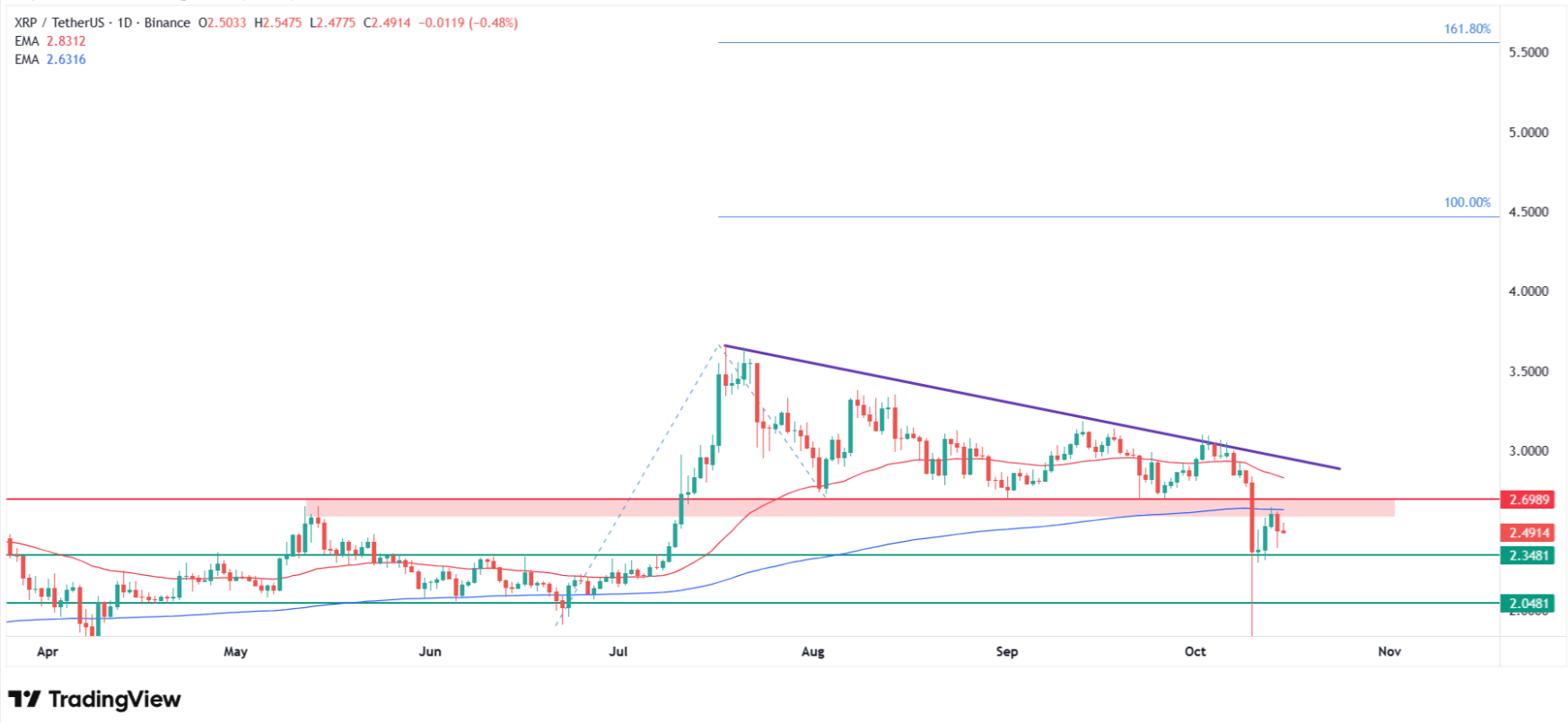
Technical analysis of the XRP price chart. Source: Tradingview.com
XRP Price Analysis, FAQ
What is XRP price
prediction for 2030?
Former
Goldman Sachs analyst Dom Kwok predicts XRP could reach $1,000 by 2030,
requiring a 31,445% increase from current $2.49 levels, though alternative
analysts like Matthew Brienen suggest this target may not materialize until
2035, with more conservative forecasts projecting $4.50-$5.50 in the next 6-12
months based on Fibonacci technical analysis.
Will XRP reach $1,000?
Achieving
$1,000 would require XRP's market cap to reach approximately $59 trillion, exceeding
all global stock markets combined, necessitating unprecedented institutional
adoption, capture of significant cross-border payment volumes ($150 trillion
annually), and regulatory clarity enabling pension fund and sovereign wealth
allocations to cryptocurrencies.
Is XRP a good investment
in October 2025?
XRP trades
at $2.49 with technical support at $2.35 and resistance at $2.70, down 16.73%
weekly amid macro headwinds from US-China trade tensions, though pending XRP
ETF approval (expected October 2025), resolution of SEC lawsuit, and 300+
institutional ODL partnerships provide long-term bullish catalysts despite
near-term volatility risks requiring careful risk management.
What affects XRP price
movement?
Key drivers
include institutional capital inflows following SEC lawsuit resolution removing
compliance barriers, pending XRP ETF approval opening retail/institutional
access, network effects from 300+ financial institutions using Ripple's ODL
technology, Federal Reserve monetary policy impacting risk asset appetite, and
geopolitical tensions creating macro headwinds for cryptocurrency markets
broadly.
Former
Goldman Sachs analyst Dom Kwok sparked intense debate across cryptocurrency
markets with his audacious XRP price prediction of $1,000 by 2030. It represent
a staggering 31,000% surge from current levels.
The
co-founder of blockchain education platform EasyA doubled down on his forecast
in recent interviews, citing institutional adoption and regulatory clarity as
pivotal catalysts for the projected rally.
XRP price
today (Wednesday), 15 October 20205, stands at $2.49 with a market
capitalization of $140.08 billion, maintaining its position as the
fifth-largest cryptocurrency by market value.
How high
can XRP price go, why technical analysis forecasts medium-term target of $5.5
and what are the newest predictions? I am answering all these questions in the
article below.
Can XRP Hit $1,000? Institutional
Capital Becomes The Missing Catalyst
This
institutional shift "is going to obviously create huge inflow with new
capital," according to Kwok, positioning XRP to capture significant
portions of these diversified allocations.
Paul
Howard, director at Wincent, reinforced this institutional narrative regarding
pending XRP exchange-traded fund applications.
"Approval of an XRP ETF is likely on the
cards," Howard stated, adding that "Ripple has been doing a fantastic
job in building their network and finding use cases for their
cryptocurrency".
An approved
ETF would "open up new avenues for their institutional and retail customer
bases," representing a net positive catalyst for token appreciation.
The
resolution of Ripple's SEC lawsuit removed a major compliance barrier that
previously deterred institutional participation.
"Obviously
now the SEC lawsuit has been removed essentially from all of their
screens," Kwok noted, enabling funds to "actually now start to really
talk about it" without legal concerns overshadowing investment decisions.
Why XRP Price Will Surge? Network
Effects Amplify Growth Trajectory
Phil Kwok,
Dom's brother and EasyA co-founder, highlighted network effects as
another fundamental driver supporting the $1,000 price target. As XRP's price
increases, it naturally attracts more developers and users to the ecosystem,
creating a self-reinforcing cycle of adoption and value appreciation. This
dynamic has already demonstrated tangible results as XRP surged 456% over the
past year to trade above $3 during peak periods, establishing itself as the
best-performing large-cap altcoin in the current market cycle.
Ripple's
expanding network of 300+ financial institutions utilizing its On-Demand
Liquidity (ODL) technology provides concrete evidence of real-world utility
driving these network effects. Each new institutional partner strengthens XRP's
position as a bridge currency for cross-border payments, potentially unlocking
trillions in global remittance volume.
Technical Analysis Shows Next
Target: $5.5
Technical
examination of XRP's chart structure reveals the cryptocurrency currently
consolidates between horizontal support at $2.35 and a confluence of resistance
levels. The resistance zone includes the critical $2.70 level—representing May
highs that previously served as support for several months—alongside the
200-day exponential moving average (200 EMA).
According
to my technical analysis, the recent price action shows XRP breaking down from
a wedge or triangle formation drawn from July highs, exiting the
pattern to the downside. This technical breakdown potentially opens the door to
stronger declines if current support at $2.35 fails, with secondary support
identified at $2.05.
However,
medium-term outlook remains constructive with bullish positioning
targeting a return toward the $3.65 level where prices traded during July peaks.
Utilizing Fibonacci extensions to project long-term targets reveals objectives
for XRP over the next six months around $4.50, with a highly optimistic
scenario aligning with the 161.8% extension near $5.50.
This upper
target would represent a 120% gain from current levels, far exceeding most
mainstream analyst forecasts yet remaining exponentially below Kwok's $1,000
projection.
Technical analysis of the XRP price chart. Source: Tradingview.com
XRP Price Analysis, FAQ
What is XRP price
prediction for 2030?
Former
Goldman Sachs analyst Dom Kwok predicts XRP could reach $1,000 by 2030,
requiring a 31,445% increase from current $2.49 levels, though alternative
analysts like Matthew Brienen suggest this target may not materialize until
2035, with more conservative forecasts projecting $4.50-$5.50 in the next 6-12
months based on Fibonacci technical analysis.
Will XRP reach $1,000?
Achieving
$1,000 would require XRP's market cap to reach approximately $59 trillion, exceeding
all global stock markets combined, necessitating unprecedented institutional
adoption, capture of significant cross-border payment volumes ($150 trillion
annually), and regulatory clarity enabling pension fund and sovereign wealth
allocations to cryptocurrencies.
Is XRP a good investment
in October 2025?
XRP trades
at $2.49 with technical support at $2.35 and resistance at $2.70, down 16.73%
weekly amid macro headwinds from US-China trade tensions, though pending XRP
ETF approval (expected October 2025), resolution of SEC lawsuit, and 300+
institutional ODL partnerships provide long-term bullish catalysts despite
near-term volatility risks requiring careful risk management.
What affects XRP price
movement?
Key drivers
include institutional capital inflows following SEC lawsuit resolution removing
compliance barriers, pending XRP ETF approval opening retail/institutional
access, network effects from 300+ financial institutions using Ripple's ODL
technology, Federal Reserve monetary policy impacting risk asset appetite, and
geopolitical tensions creating macro headwinds for cryptocurrency markets
broadly.
Damian's adventure with financial markets began at the Cracow University of Economics, where he obtained his MA in finance and accounting. Starting from the retail trader perspective, he collaborated with brokerage houses and financial portals in Poland as an independent editor and content manager. His adventure with Finance Magnates began in 2016, where he is working as a business intelligence analyst.
In this conversation, we sit down with Drew Niv, CSO at ATFX Connect and one of the most influential figures in modern FX.
We speak about market structure, the institutional view on liquidity, and the sharp rise of prop trading, a sector Drew has been commenting on in recent months. Drew explains why he once dismissed prop trading, why his view changed, and what he now thinks the model means for brokers, clients and risk managers.
We explore subscription-fee dependency, the high reneging rate, and the long-term challenge: how brokers can build a more stable and honest version of the model. Drew also talks about the traffic advantage standalone prop firms have built and why brokers may still win in the long run if they take the right approach.
In this conversation, we sit down with Drew Niv, CSO at ATFX Connect and one of the most influential figures in modern FX.
We speak about market structure, the institutional view on liquidity, and the sharp rise of prop trading, a sector Drew has been commenting on in recent months. Drew explains why he once dismissed prop trading, why his view changed, and what he now thinks the model means for brokers, clients and risk managers.
We explore subscription-fee dependency, the high reneging rate, and the long-term challenge: how brokers can build a more stable and honest version of the model. Drew also talks about the traffic advantage standalone prop firms have built and why brokers may still win in the long run if they take the right approach.
In this conversation, we sit down with Drew Niv, CSO at ATFX Connect and one of the most influential figures in modern FX.
We speak about market structure, the institutional view on liquidity, and the sharp rise of prop trading, a sector Drew has been commenting on in recent months. Drew explains why he once dismissed prop trading, why his view changed, and what he now thinks the model means for brokers, clients and risk managers.
We explore subscription-fee dependency, the high reneging rate, and the long-term challenge: how brokers can build a more stable and honest version of the model. Drew also talks about the traffic advantage standalone prop firms have built and why brokers may still win in the long run if they take the right approach.
In this conversation, we sit down with Drew Niv, CSO at ATFX Connect and one of the most influential figures in modern FX.
We speak about market structure, the institutional view on liquidity, and the sharp rise of prop trading, a sector Drew has been commenting on in recent months. Drew explains why he once dismissed prop trading, why his view changed, and what he now thinks the model means for brokers, clients and risk managers.
We explore subscription-fee dependency, the high reneging rate, and the long-term challenge: how brokers can build a more stable and honest version of the model. Drew also talks about the traffic advantage standalone prop firms have built and why brokers may still win in the long run if they take the right approach.
Executive Interview | Remonda Z. Kirketerp Møller| CEO & Founder Muinmos | FMLS:25
In this interview, Remonda Z. Kirketerp Møller, founder of Muinmos, breaks down the state of AI in regtech and what responsible adoption really looks like for brokers. We talk about rising fragmentation, the pressures around compliance accuracy, and why most firms are still in the early stages of AI maturity.
Ramanda also shares insights on regulator sandboxes, shifting expectations around accountability, and the current reality of MiCA licensing and passporting in Europe.
A concise look at where compliance, onboarding, and AI-driven processes are heading next.
In this interview, Remonda Z. Kirketerp Møller, founder of Muinmos, breaks down the state of AI in regtech and what responsible adoption really looks like for brokers. We talk about rising fragmentation, the pressures around compliance accuracy, and why most firms are still in the early stages of AI maturity.
Ramanda also shares insights on regulator sandboxes, shifting expectations around accountability, and the current reality of MiCA licensing and passporting in Europe.
A concise look at where compliance, onboarding, and AI-driven processes are heading next.
In this interview, Remonda Z. Kirketerp Møller, founder of Muinmos, breaks down the state of AI in regtech and what responsible adoption really looks like for brokers. We talk about rising fragmentation, the pressures around compliance accuracy, and why most firms are still in the early stages of AI maturity.
Ramanda also shares insights on regulator sandboxes, shifting expectations around accountability, and the current reality of MiCA licensing and passporting in Europe.
A concise look at where compliance, onboarding, and AI-driven processes are heading next.
In this interview, Remonda Z. Kirketerp Møller, founder of Muinmos, breaks down the state of AI in regtech and what responsible adoption really looks like for brokers. We talk about rising fragmentation, the pressures around compliance accuracy, and why most firms are still in the early stages of AI maturity.
Ramanda also shares insights on regulator sandboxes, shifting expectations around accountability, and the current reality of MiCA licensing and passporting in Europe.
A concise look at where compliance, onboarding, and AI-driven processes are heading next.
In this interview, Remonda Z. Kirketerp Møller, founder of Muinmos, breaks down the state of AI in regtech and what responsible adoption really looks like for brokers. We talk about rising fragmentation, the pressures around compliance accuracy, and why most firms are still in the early stages of AI maturity.
Ramanda also shares insights on regulator sandboxes, shifting expectations around accountability, and the current reality of MiCA licensing and passporting in Europe.
A concise look at where compliance, onboarding, and AI-driven processes are heading next.
In this interview, Remonda Z. Kirketerp Møller, founder of Muinmos, breaks down the state of AI in regtech and what responsible adoption really looks like for brokers. We talk about rising fragmentation, the pressures around compliance accuracy, and why most firms are still in the early stages of AI maturity.
Ramanda also shares insights on regulator sandboxes, shifting expectations around accountability, and the current reality of MiCA licensing and passporting in Europe.
A concise look at where compliance, onboarding, and AI-driven processes are heading next.
In this conversation, we speak with Aydin Bonabi, CEO and co-founder of Surveill, a firm focused on fraud detection and AI-driven compliance tools for financial institutions.
We start with Aydin’s view of the Summit and the challenges brokers face as fraud tactics grow more complex. He explains how firms can stay ahead through real-time signals, data patterns, and early-stage detection.
We also talk about AI training and why compliance teams often struggle to keep models accurate, fair, and aligned with regulatory expectations. Aydin breaks down what “good” AI training looks like inside a financial environment, including the importance of clean data, domain expertise, and human oversight.
He closes with a clear message: fraud is scaling, and so must the tools that stop it.
In this conversation, we speak with Aydin Bonabi, CEO and co-founder of Surveill, a firm focused on fraud detection and AI-driven compliance tools for financial institutions.
We start with Aydin’s view of the Summit and the challenges brokers face as fraud tactics grow more complex. He explains how firms can stay ahead through real-time signals, data patterns, and early-stage detection.
We also talk about AI training and why compliance teams often struggle to keep models accurate, fair, and aligned with regulatory expectations. Aydin breaks down what “good” AI training looks like inside a financial environment, including the importance of clean data, domain expertise, and human oversight.
He closes with a clear message: fraud is scaling, and so must the tools that stop it.
In this conversation, we speak with Aydin Bonabi, CEO and co-founder of Surveill, a firm focused on fraud detection and AI-driven compliance tools for financial institutions.
We start with Aydin’s view of the Summit and the challenges brokers face as fraud tactics grow more complex. He explains how firms can stay ahead through real-time signals, data patterns, and early-stage detection.
We also talk about AI training and why compliance teams often struggle to keep models accurate, fair, and aligned with regulatory expectations. Aydin breaks down what “good” AI training looks like inside a financial environment, including the importance of clean data, domain expertise, and human oversight.
He closes with a clear message: fraud is scaling, and so must the tools that stop it.
In this conversation, we speak with Aydin Bonabi, CEO and co-founder of Surveill, a firm focused on fraud detection and AI-driven compliance tools for financial institutions.
We start with Aydin’s view of the Summit and the challenges brokers face as fraud tactics grow more complex. He explains how firms can stay ahead through real-time signals, data patterns, and early-stage detection.
We also talk about AI training and why compliance teams often struggle to keep models accurate, fair, and aligned with regulatory expectations. Aydin breaks down what “good” AI training looks like inside a financial environment, including the importance of clean data, domain expertise, and human oversight.
He closes with a clear message: fraud is scaling, and so must the tools that stop it.
In this conversation, we speak with Aydin Bonabi, CEO and co-founder of Surveill, a firm focused on fraud detection and AI-driven compliance tools for financial institutions.
We start with Aydin’s view of the Summit and the challenges brokers face as fraud tactics grow more complex. He explains how firms can stay ahead through real-time signals, data patterns, and early-stage detection.
We also talk about AI training and why compliance teams often struggle to keep models accurate, fair, and aligned with regulatory expectations. Aydin breaks down what “good” AI training looks like inside a financial environment, including the importance of clean data, domain expertise, and human oversight.
He closes with a clear message: fraud is scaling, and so must the tools that stop it.
In this conversation, we speak with Aydin Bonabi, CEO and co-founder of Surveill, a firm focused on fraud detection and AI-driven compliance tools for financial institutions.
We start with Aydin’s view of the Summit and the challenges brokers face as fraud tactics grow more complex. He explains how firms can stay ahead through real-time signals, data patterns, and early-stage detection.
We also talk about AI training and why compliance teams often struggle to keep models accurate, fair, and aligned with regulatory expectations. Aydin breaks down what “good” AI training looks like inside a financial environment, including the importance of clean data, domain expertise, and human oversight.
He closes with a clear message: fraud is scaling, and so must the tools that stop it.
Exness expands its presence in Africa: Inside our interview with Paul Margarites in Cape Town
Finance Magnates met with Paul Margarites, Exness regional commercial director for Sub-Saharan Africa, during a visit to the firm’s office opening in Cape Town. In this talk, led by Andrea Badiola Mateos, Co-CEO at Finance Magnates, Paul shares views on the South African trading space, local user behavior, mobile trends, regulation, team growth, and how Exness plans to grow in more markets across the region. @Exness
Read the article at: https://www.financemagnates.com/thought-leadership/exness-expands-its-presence-in-africa-inside-our-interview-with-paul-margarites/
#exness #financemagnates #exnesstrading #CFDtrading #tradeonline #africanews #capetown
Finance Magnates met with Paul Margarites, Exness regional commercial director for Sub-Saharan Africa, during a visit to the firm’s office opening in Cape Town. In this talk, led by Andrea Badiola Mateos, Co-CEO at Finance Magnates, Paul shares views on the South African trading space, local user behavior, mobile trends, regulation, team growth, and how Exness plans to grow in more markets across the region. @Exness
Read the article at: https://www.financemagnates.com/thought-leadership/exness-expands-its-presence-in-africa-inside-our-interview-with-paul-margarites/
#exness #financemagnates #exnesstrading #CFDtrading #tradeonline #africanews #capetown
Finance Magnates met with Paul Margarites, Exness regional commercial director for Sub-Saharan Africa, during a visit to the firm’s office opening in Cape Town. In this talk, led by Andrea Badiola Mateos, Co-CEO at Finance Magnates, Paul shares views on the South African trading space, local user behavior, mobile trends, regulation, team growth, and how Exness plans to grow in more markets across the region. @Exness
Read the article at: https://www.financemagnates.com/thought-leadership/exness-expands-its-presence-in-africa-inside-our-interview-with-paul-margarites/
#exness #financemagnates #exnesstrading #CFDtrading #tradeonline #africanews #capetown
Finance Magnates met with Paul Margarites, Exness regional commercial director for Sub-Saharan Africa, during a visit to the firm’s office opening in Cape Town. In this talk, led by Andrea Badiola Mateos, Co-CEO at Finance Magnates, Paul shares views on the South African trading space, local user behavior, mobile trends, regulation, team growth, and how Exness plans to grow in more markets across the region. @Exness
Read the article at: https://www.financemagnates.com/thought-leadership/exness-expands-its-presence-in-africa-inside-our-interview-with-paul-margarites/
#exness #financemagnates #exnesstrading #CFDtrading #tradeonline #africanews #capetown
Finance Magnates met with Paul Margarites, Exness regional commercial director for Sub-Saharan Africa, during a visit to the firm’s office opening in Cape Town. In this talk, led by Andrea Badiola Mateos, Co-CEO at Finance Magnates, Paul shares views on the South African trading space, local user behavior, mobile trends, regulation, team growth, and how Exness plans to grow in more markets across the region. @Exness
Read the article at: https://www.financemagnates.com/thought-leadership/exness-expands-its-presence-in-africa-inside-our-interview-with-paul-margarites/
#exness #financemagnates #exnesstrading #CFDtrading #tradeonline #africanews #capetown
Finance Magnates met with Paul Margarites, Exness regional commercial director for Sub-Saharan Africa, during a visit to the firm’s office opening in Cape Town. In this talk, led by Andrea Badiola Mateos, Co-CEO at Finance Magnates, Paul shares views on the South African trading space, local user behavior, mobile trends, regulation, team growth, and how Exness plans to grow in more markets across the region. @Exness
Read the article at: https://www.financemagnates.com/thought-leadership/exness-expands-its-presence-in-africa-inside-our-interview-with-paul-margarites/
#exness #financemagnates #exnesstrading #CFDtrading #tradeonline #africanews #capetown
Executive Interview | Jas Shah | FMLS:25
Interview with Jas Shah
Builder | Adviser | Fintech Writer | Product Strategist
In this episode, Jonathan Fine sat down with Jas Shah, one of the most thoughtful voices in global fintech. Known for his work across advisory, product, stablecoins, and his widely read writing, Jas brings a rare combination of industry insight and plain-spoken clarity.
We talk about his first impression of the Summit, the projects that keep him busy today, and how they connect to the stablecoin panel he joined. Jas shares his view on the link between fintech, wealthtech and retail brokers, especially as firms like Revolut, eToro and Trading212 blur long-standing lines in the market.
We also explore what stablecoin adoption might look like for retail investment platforms, including a few product and UX angles that are not obvious at first glance.
To close, Jas explains how he thinks about writing, and how he approaches “shipping” pieces that spark debate across the industry.
Interview with Jas Shah
Builder | Adviser | Fintech Writer | Product Strategist
In this episode, Jonathan Fine sat down with Jas Shah, one of the most thoughtful voices in global fintech. Known for his work across advisory, product, stablecoins, and his widely read writing, Jas brings a rare combination of industry insight and plain-spoken clarity.
We talk about his first impression of the Summit, the projects that keep him busy today, and how they connect to the stablecoin panel he joined. Jas shares his view on the link between fintech, wealthtech and retail brokers, especially as firms like Revolut, eToro and Trading212 blur long-standing lines in the market.
We also explore what stablecoin adoption might look like for retail investment platforms, including a few product and UX angles that are not obvious at first glance.
To close, Jas explains how he thinks about writing, and how he approaches “shipping” pieces that spark debate across the industry.
Interview with Jas Shah
Builder | Adviser | Fintech Writer | Product Strategist
In this episode, Jonathan Fine sat down with Jas Shah, one of the most thoughtful voices in global fintech. Known for his work across advisory, product, stablecoins, and his widely read writing, Jas brings a rare combination of industry insight and plain-spoken clarity.
We talk about his first impression of the Summit, the projects that keep him busy today, and how they connect to the stablecoin panel he joined. Jas shares his view on the link between fintech, wealthtech and retail brokers, especially as firms like Revolut, eToro and Trading212 blur long-standing lines in the market.
We also explore what stablecoin adoption might look like for retail investment platforms, including a few product and UX angles that are not obvious at first glance.
To close, Jas explains how he thinks about writing, and how he approaches “shipping” pieces that spark debate across the industry.
Interview with Jas Shah
Builder | Adviser | Fintech Writer | Product Strategist
In this episode, Jonathan Fine sat down with Jas Shah, one of the most thoughtful voices in global fintech. Known for his work across advisory, product, stablecoins, and his widely read writing, Jas brings a rare combination of industry insight and plain-spoken clarity.
We talk about his first impression of the Summit, the projects that keep him busy today, and how they connect to the stablecoin panel he joined. Jas shares his view on the link between fintech, wealthtech and retail brokers, especially as firms like Revolut, eToro and Trading212 blur long-standing lines in the market.
We also explore what stablecoin adoption might look like for retail investment platforms, including a few product and UX angles that are not obvious at first glance.
To close, Jas explains how he thinks about writing, and how he approaches “shipping” pieces that spark debate across the industry.
Interview with Jas Shah
Builder | Adviser | Fintech Writer | Product Strategist
In this episode, Jonathan Fine sat down with Jas Shah, one of the most thoughtful voices in global fintech. Known for his work across advisory, product, stablecoins, and his widely read writing, Jas brings a rare combination of industry insight and plain-spoken clarity.
We talk about his first impression of the Summit, the projects that keep him busy today, and how they connect to the stablecoin panel he joined. Jas shares his view on the link between fintech, wealthtech and retail brokers, especially as firms like Revolut, eToro and Trading212 blur long-standing lines in the market.
We also explore what stablecoin adoption might look like for retail investment platforms, including a few product and UX angles that are not obvious at first glance.
To close, Jas explains how he thinks about writing, and how he approaches “shipping” pieces that spark debate across the industry.
Interview with Jas Shah
Builder | Adviser | Fintech Writer | Product Strategist
In this episode, Jonathan Fine sat down with Jas Shah, one of the most thoughtful voices in global fintech. Known for his work across advisory, product, stablecoins, and his widely read writing, Jas brings a rare combination of industry insight and plain-spoken clarity.
We talk about his first impression of the Summit, the projects that keep him busy today, and how they connect to the stablecoin panel he joined. Jas shares his view on the link between fintech, wealthtech and retail brokers, especially as firms like Revolut, eToro and Trading212 blur long-standing lines in the market.
We also explore what stablecoin adoption might look like for retail investment platforms, including a few product and UX angles that are not obvious at first glance.
To close, Jas explains how he thinks about writing, and how he approaches “shipping” pieces that spark debate across the industry.